
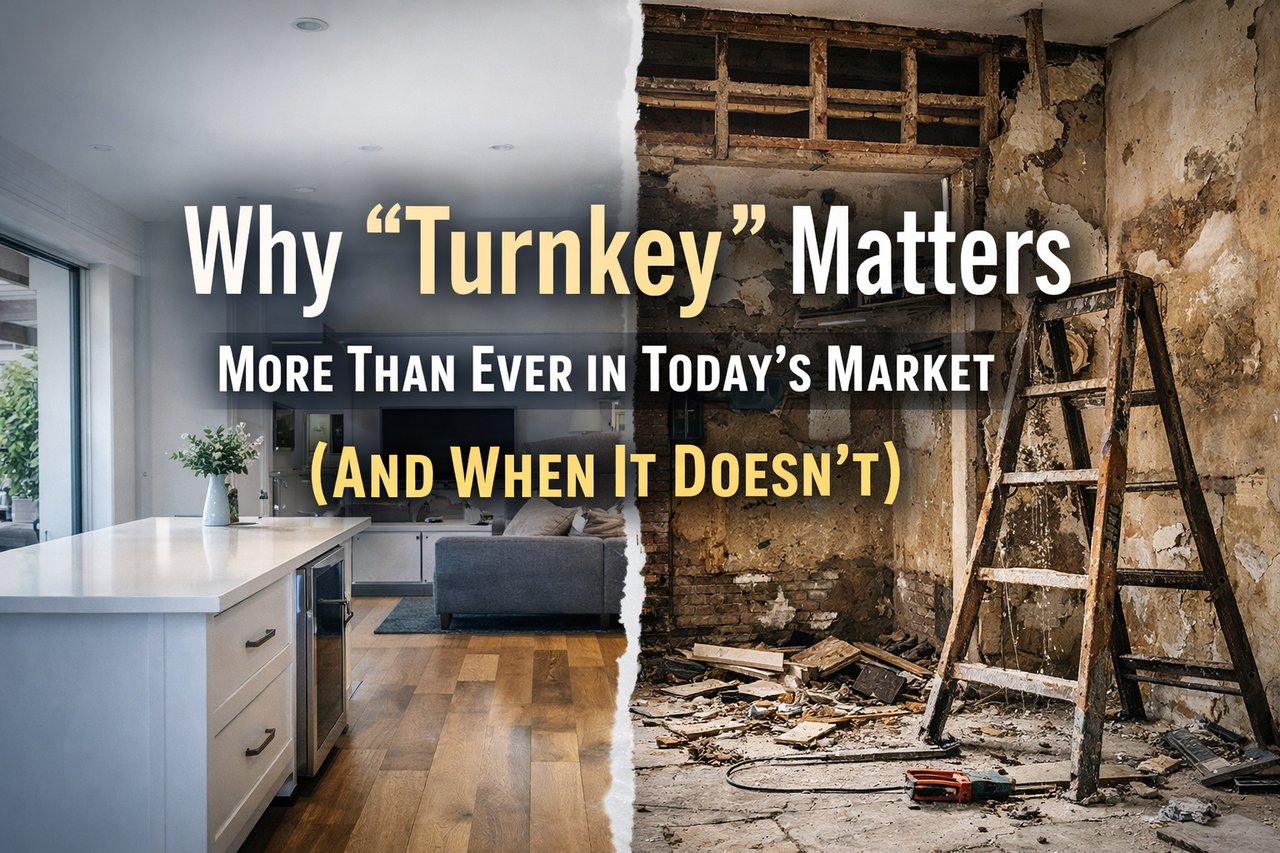
Let’s get one thing straight: turnkey isn’t a buzzword. It’s a reaction.
A reaction to exhaustion. To uncertainty. To buyers who are done pretending they have the time, money, or patience to manage a renovation they’ve never done before.
In 2026, turnkey matters again—not because people are lazy, but because they’re realistic.
And no, that doesn’t mean fixers are dead. It just means strategy finally matters more than optimism.
What “Turnkey” Actually Means (and What It Doesn’t)
Turnkey does not mean luxury.
It does not mean perfect design, trending finishes, or something straight out of a magazine.
Turnkey means:
-
The big stuff works
-
The home is immediately livable
-
You’re not writing checks the minute you get the keys
That’s it.
Buyers aren’t chasing perfection right now. They’re chasing certainty.
Why Buyers Are Paying Premiums for Turnkey in 2026
Even with more inventory and price reductions, turnkey homes are still pulling stronger offers. That’s not an accident.
Here’s why:
-
Renovation fatigue is real
-
Contractors are expensive and booked
-
Permits take longer than people expect
-
“It’ll only take a few months” is almost never true
Buyers aren’t dumb. They’ve watched friends blow budgets and live in chaos for a year longer than planned. They’ve done the math. And many of them are saying, absolutely not.
Paying more upfront feels safer than gambling later.
The Hidden Cost of “We’ll Just Update It Later”
This is where things go sideways.
Most buyers dramatically underestimate:
-
How long projects take
-
How often costs escalate
-
How emotionally draining decision fatigue becomes
-
How quickly small projects turn into big ones
What starts as a “smart value play” can quietly turn into stress, resentment, and overspending.
That’s not a moral failure. It’s just reality.
When Buying a Fixer Does Make Sense
Fixers aren’t bad. They’re just not casual.
A fixer makes sense when:
-
The buyer has real renovation experience (not Pinterest confidence)
-
The price truly reflects the work
-
The location does heavy lifting
-
The buyer plans to stay long enough to justify the pain
A fixer should be a strategic decision, not a hopeful one.
What Sellers Get Wrong About Improvements vs. Pricing
Here’s the part sellers don’t love hearing:
Half-updating a home is often worse than doing nothing.
In this market, homes tend to perform best when they are either:
-
Clearly turnkey
-
Or clearly priced for condition
The in-between is where listings stall.
Buyers don’t want to inherit unfinished decisions—or pay turnkey prices for a home that still feels like a project.
This is where ego can get expensive.
Final Takeaway: Strategy > Condition
Turnkey isn’t about being fancy. It’s about removing friction.
Fixers aren’t about saving money. They’re about tolerance for risk.
The mistake I see most often isn’t choosing one over the other—it’s choosing without a strategy.
Condition matters. Timing matters. Pricing matters.
But strategy is what separates smooth outcomes from painful ones.
And in this market, that difference is the whole damn thing.
